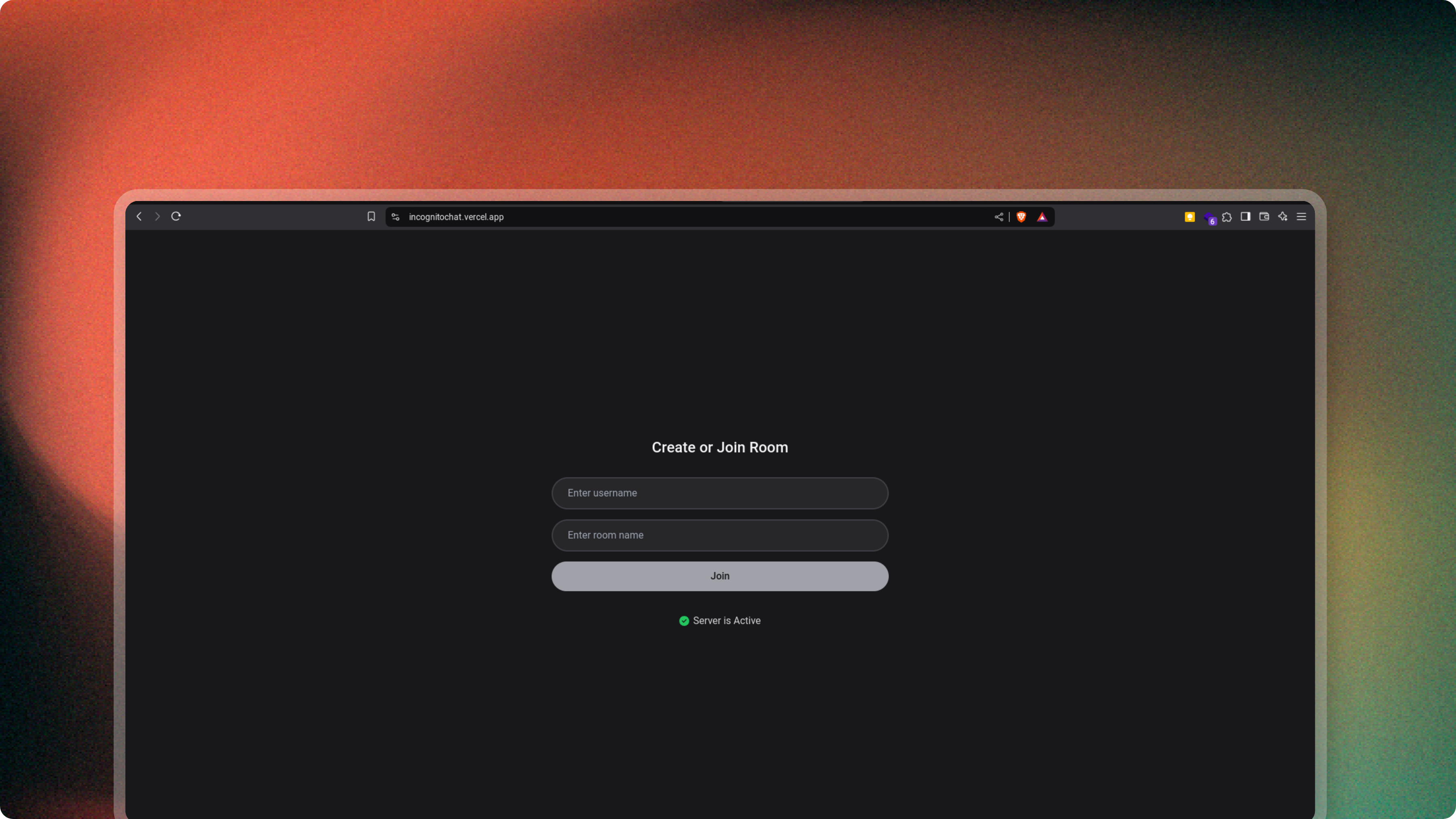
NixChat
Chat anonymously without worrying about privacy.
Overview
NixChat is a minimal real-time chat platform designed around anonymous and private communication.
Unlike most messaging platforms that revolve around identities, profiles, and social graphs, NixChat focuses purely on the conversation itself. Users can join a chat session instantly without creating accounts or revealing personal information.
The project was built as an experiment to explore WebSocket-based real-time systems while intentionally stripping away identity layers to create a lightweight and privacy-first chat experience.
Problem
Most messaging platforms are built around user identity. Accounts, profiles, friend lists, and persistent history often become the core of the system.
While useful for social platforms, this approach introduces privacy concerns and unnecessary friction for simple conversations.
I wanted to explore the opposite design philosophy:
- no accounts
- no personal identities
- instant chat sessions
- minimal data storage
The goal was to build a chat system that focuses purely on real-time communication.
Constraints
- No authentication system – conversations must work without user accounts.
- Session-based identity – users still need temporary identifiers for message routing.
- Real-time performance – messages should appear instantly across connected clients.
- Minimal infrastructure – the system should remain lightweight and easy to deploy.
- Privacy-first design – avoid unnecessary data persistence.
Key Engineering Decisions
WebSocket-based messaging
Real-time communication is implemented using Socket.IO to maintain persistent connections between clients and the server.
Reason:
WebSockets enable low-latency message delivery and bidirectional communication.
Tradeoff:
Persistent connections require careful handling of connection lifecycle and room management.
Ephemeral session identities
Instead of user accounts, each client receives a temporary session identifier.
Reason:
This allows message routing between clients without storing permanent user identities.
Tradeoff:
Sessions are temporary and cannot be restored after disconnecting.
Room-based message routing
Chat sessions are implemented using Socket.IO rooms.
Reason:
Rooms allow users to join conversations dynamically while keeping message routing simple.
Tradeoff:
Requires managing room membership and session lifecycle.
Minimal frontend state management
Zustand is used to manage client-side state such as:
- active chat sessions
- message history
- connection state
Reason:
Provides simple global state management without unnecessary complexity.
Tradeoff:
State resets when the session ends.
Results
- Built a lightweight anonymous chat platform.
- Implemented real-time messaging using WebSockets.
- Enabled instant chat sessions without authentication.
- Designed a minimal UI focused on conversation rather than identity.
Takeaways
Building NixChat helped explore the design tradeoffs of anonymity in real-time communication systems.
Key lessons:
- Real-time chat systems rely heavily on connection and room management.
- Anonymous communication requires alternative identity models such as session-based identifiers.
- Simpler systems often require fewer infrastructure components but careful design decisions.
- Minimal product design can still deliver meaningful user experiences.