TypeScript Node.js React Socket.IO MongoDB Zustand Zod Monaco Editor Face-api.js Judge0 Recharts ShadcnUI
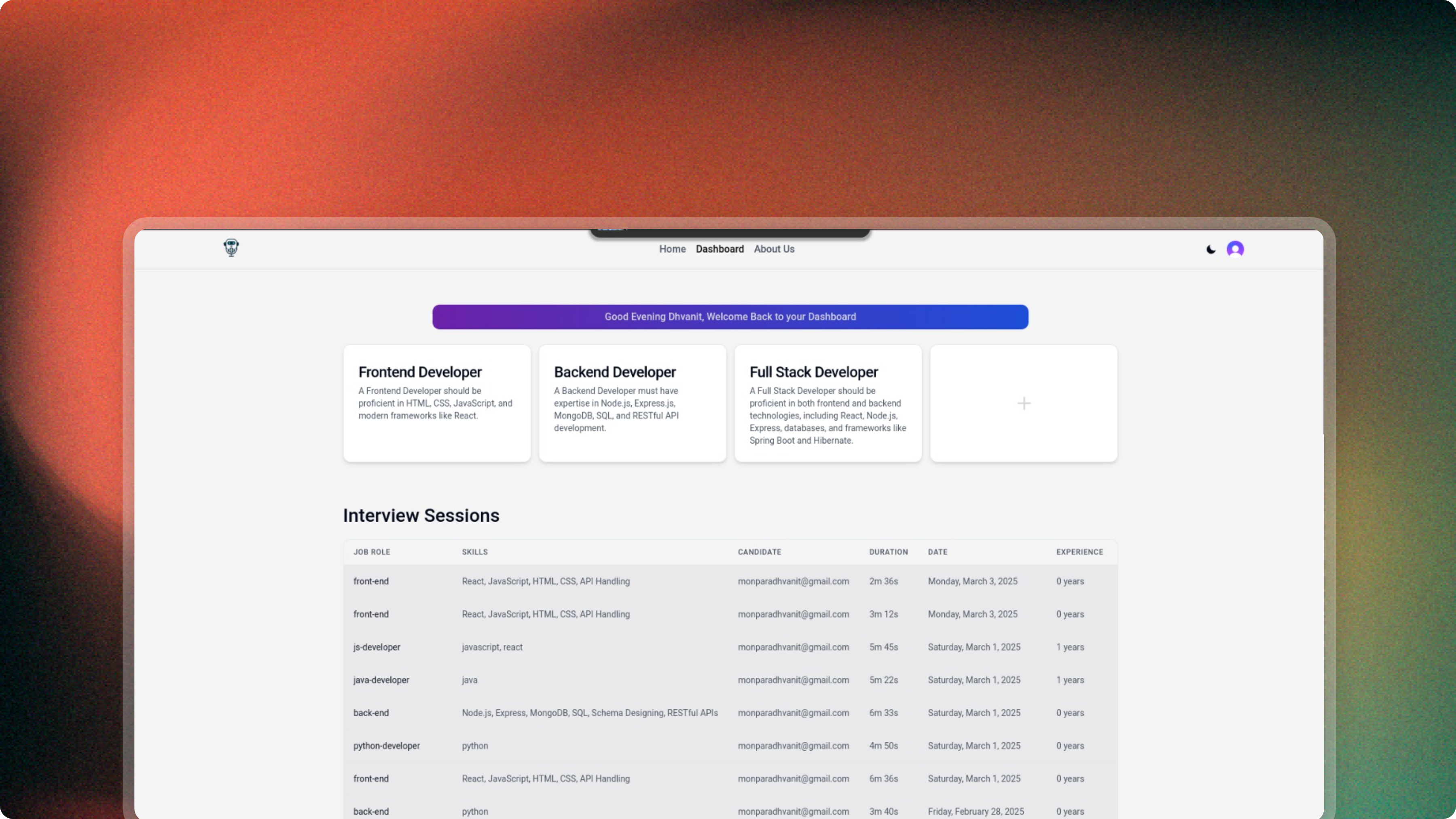
An AI-powered interview platform with live video, face expression tracking, and real-time coding evaluation.
TypeScript Node.js React Socket.IO MongoDB Zustand Zod Monaco Editor Face-api.js Judge0 Recharts ShadcnUI
HireMe is an AI-assisted technical interview platform built during the SKIPS University BrahmaCode Hackathon.
The platform aims to make technical interviews more structured and data-driven by combining live coding assessments with behavioral signals such as facial expressions and candidate engagement.
The system allows interviewers to conduct real-time coding interviews while simultaneously monitoring candidate behavior, generating analytics, and evaluating coding performance.
The project was built in 36 hours by a team of five, resulting in a fully functional prototype that won 1st prize (₹50,000) at the hackathon.
Traditional technical interviews rely heavily on subjective evaluation and limited signals. Interviewers often struggle to assess:
Additionally, many interview processes require separate tools for video calls, coding environments, and evaluation metrics.
The goal of HireMe was to build a single platform that combines live interviews, coding evaluation, and behavioral analytics to create a more transparent and structured hiring process.
Socket.IO was used to synchronize interview events between interviewer and candidate including code updates, session state, and live interactions.
Reason:
Real-time communication is essential for collaborative coding interviews.
Tradeoff:
Managing connection state and synchronization across multiple clients adds complexity.
The coding interface was built using Monaco Editor, the same editor used in VS Code.
Reason:
Provides a familiar development experience and supports syntax highlighting, multiple languages, and editor extensions.
Tradeoff:
Embedding a full-featured code editor increases frontend complexity.
Code submissions were evaluated using the Judge0 API to run candidate code in isolated environments.
Reason:
Building a secure code execution environment from scratch is complex and risky.
Tradeoff:
External API dependency for code execution.
Face-api.js was used to detect facial expressions and engagement signals from the candidate’s webcam during interviews.
Reason:
Provides browser-based machine learning models capable of running facial detection without requiring server-side processing.
Tradeoff:
Browser-based ML models may have accuracy limitations depending on lighting and camera quality.
Interview performance and behavioral signals were visualized using Recharts.
Reason:
Providing interview analytics helps interviewers evaluate candidates beyond coding performance.
Tradeoff:
Behavioral metrics should be interpreted carefully to avoid biased conclusions.
Building HireMe under hackathon constraints highlighted the importance of rapid architecture decisions and practical tradeoffs.
Key lessons: