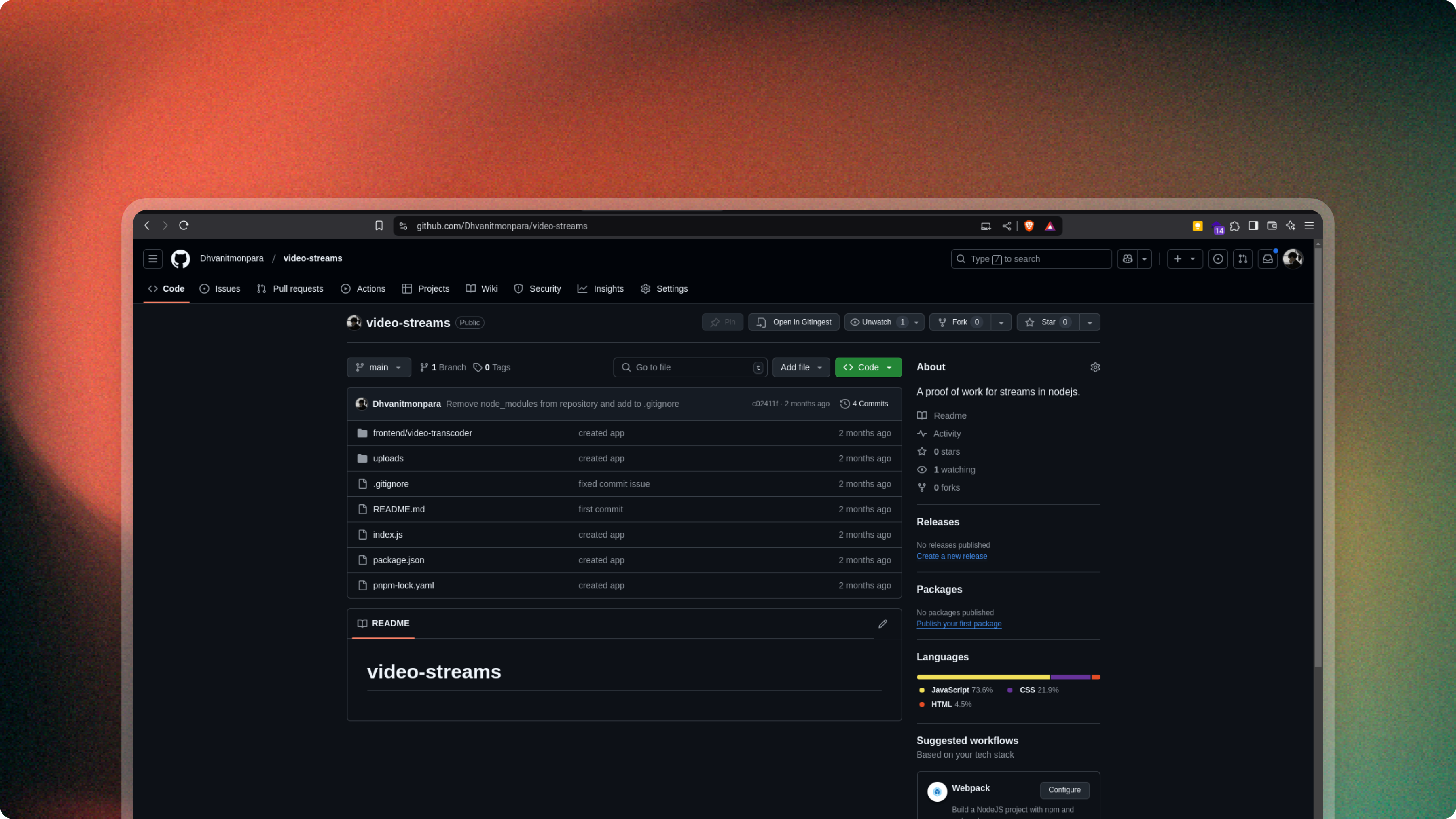
PoC for video Streams
Implemented video streaming using Socket.io and FFmpeg.
Overview
This project is a proof of concept exploring how live video streams can be processed and distributed using server-side media pipelines.
The system uses FFmpeg to process video input and stream it through a Node.js server, while Socket.IO is used to distribute the video data to connected clients. The frontend uses Video.js to render the stream in the browser.
The project was built as an experiment to better understand how video data is encoded, processed, and transmitted in real-time streaming systems.
Problem
Video streaming platforms rely on complex pipelines to capture, encode, and distribute media streams across networks.
While working with real-time applications, I wanted to explore how raw video streams are processed and delivered to multiple viewers using server-side tools.
The goal of this project was to understand the core mechanics behind:
- video encoding and processing
- media streaming pipelines
- server-based video distribution
- real-time playback in browsers
Constraints
- Media processing complexity – video streams must be encoded and transmitted efficiently.
- Low latency requirements – streaming delays should remain minimal.
- Browser playback compatibility – streams must be playable in modern browsers.
- Minimal infrastructure – the system focuses on experimentation rather than production-scale streaming.
Key Engineering Decisions
FFmpeg for media processing
FFmpeg was used to handle video processing and stream encoding before sending data to clients.
Reason:
FFmpeg is a powerful multimedia framework capable of handling encoding, decoding, and stream manipulation.
Tradeoff:
Working with FFmpeg requires careful configuration of codecs and streaming parameters.
Socket.IO for stream distribution
Socket.IO was used to push video data from the server to connected clients in real time.
Reason:
Provides a simple mechanism for streaming data over persistent connections.
Tradeoff:
Not optimized for large-scale video distribution compared to specialized streaming protocols.
Browser playback using Video.js
Video.js was used to render and control video playback on the client.
Reason:
Provides a flexible player with support for various streaming formats and browser compatibility.
Tradeoff:
Player behavior depends on the streaming format provided by the server.
Results
- Built a working proof of concept for server-based video streaming.
- Processed video streams using FFmpeg.
- Distributed video data to clients using Socket.IO.
- Enabled real-time playback in browsers through Video.js.
Takeaways
Building this project helped explore the fundamentals behind media streaming pipelines.
Key lessons:
- Media streaming systems rely heavily on encoding and processing pipelines.
- FFmpeg is a powerful tool for handling video transformation and streaming.
- Real-time video distribution requires careful consideration of bandwidth and latency.
- Streaming video efficiently often requires specialized protocols and infrastructure.